In today’s hyper-competitive digital landscape, the ability to innovate rapidly is no longer a luxury—it is a core requirement for survival and growth. Businesses are under constant pressure to develop, launch, and iterate on new applications and services to meet evolving customer demands. However, traditional software development models are often hindered by slow, complex, and costly infrastructure management.
This is where Platform-as-a-Service (PaaS) emerges as a transformative force. By providing a comprehensive cloud-based environment for application development, PaaS removes critical roadblocks, empowering organizations to accelerate their innovation cycles, reduce operational overhead, and gain a significant competitive edge.
What exactly is Platform-as-a-Service?
Platform-as-a-Service, commonly known as PaaS, is a cloud computing model that offers a complete platform for developing, running, and managing applications without the complexity of building and maintaining the underlying infrastructure. Think of it as a fully equipped workshop for software developers. While Infrastructure-as-a-Service (IaaS) provides the basic building blocks like servers, storage, and networking, and Software-as-a-Service (SaaS) delivers ready-to-use applications, PaaS occupies the crucial middle ground.
It provides the hardware and software tools, all hosted in the cloud, including:
- Operating systems
- Middleware
- Database management systems
- Development frameworks
This abstraction allows development teams to focus exclusively on writing code and creating business value, rather than getting bogged down in server configuration, software updates, or infrastructure maintenance.
How does PaaS accelerate time-to-market and reduce costs?
One of the most compelling value propositions of PaaS is its dual ability to dramatically speed up the delivery of new applications while simultaneously lowering overall expenses. This powerful combination is achieved by fundamentally re-engineering the development workflow and shifting the economic model of IT infrastructure. By abstracting away time-consuming setup and maintenance tasks, PaaS allows businesses to redirect their financial and human resources from operational upkeep to strategic innovation, creating a direct path to faster, more cost-effective growth.
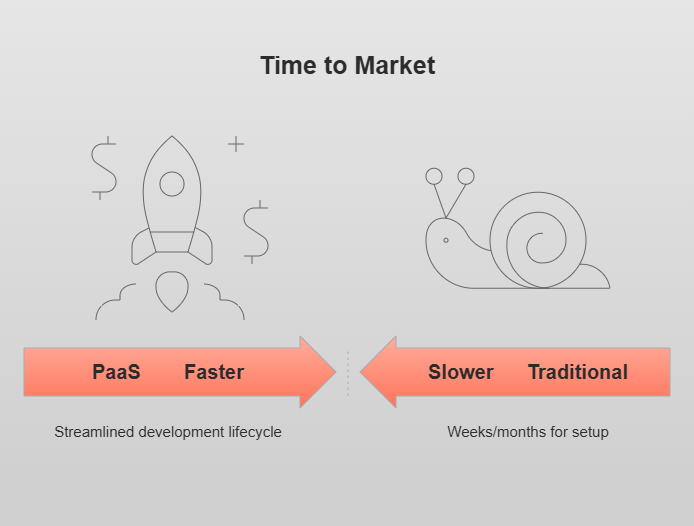
By streamlining the entire development lifecycle
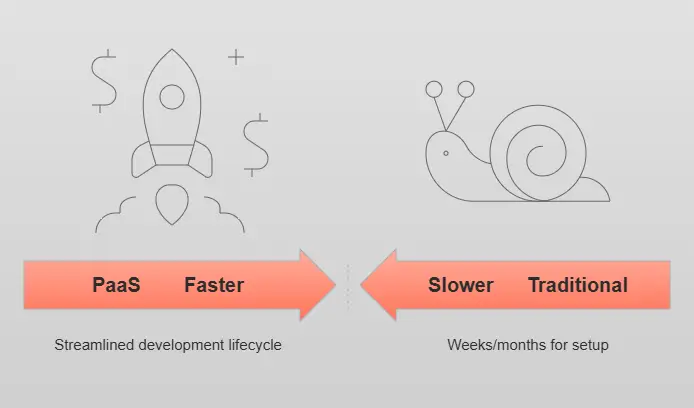
PaaS acts as a powerful accelerator by streamlining every phase of the application lifecycle, from initial concept to deployment and ongoing updates. The platform provides pre-configured environments and integrated development tools that eliminate the weeks or even months traditionally required to procure, install, and configure hardware and software.
PaaS automates repetitive tasks and standardizes best practices with built-in features such as:
- Version control
- Automated testing
- Continuous integration/continuous deployment (CI/CD) pipelines
This allows development teams to build, test, and deploy new products and features significantly faster. By removing these logistical and technical barriers, PaaS facilitates a rapid time to market, enabling businesses to seize emerging opportunities and respond to market changes with unprecedented speed.
By minimizing infrastructure and operational expenses
The financial benefits of adopting PaaS are substantial and multifaceted. The model completely eliminates the need for capital expenditure on physical hardware, servers, and networking equipment, as this is all managed by the provider. Instead, businesses operate on a pay-as-you-go model, converting large upfront costs into predictable operational expenses.
This cost reduction extends beyond hardware; PaaS also lowers the overhead associated with software licensing, maintenance, and the IT staff required to manage the infrastructure. By outsourcing the management of the platform, companies can free up their most valuable technical talent to focus on innovation and core business logic rather than routine infrastructure management, leading to significant long-term savings.
How does PaaS enhance operational agility and scalability?
In a business environment defined by unpredictability, operational agility and scalability are paramount. The ability to quickly adapt to market shifts, handle fluctuating customer demand, and pivot strategies without being constrained by technology is a key differentiator. PaaS is inherently designed to provide this level of flexibility. It empowers organizations to build resilient, high-performance applications that can grow and evolve in lockstep with the business, ensuring that technology serves as an enabler of change, not a bottleneck.
By enabling seamless resource scaling to meet demand
A core feature of PaaS is its inherent scalability. PaaS platforms are built to allow applications to scale resources up or down automatically based on real-time demand. Whether facing a sudden surge in user traffic from a marketing campaign or a predictable seasonal peak, the platform can dynamically allocate more computing power, memory, and storage to ensure the application remains fast and responsive.
Conversely, it can scale down during quiet periods to save costs. This elastic resource management provides a significant advantage over traditional on-premise infrastructure, where scaling is a slow, manual, and expensive process that often involves purchasing and provisioning new physical servers. With PaaS, businesses can innovate confidently, knowing their applications can handle success without performance degradation.
By automating routine maintenance and updates
PaaS significantly boosts operational agility by offloading the burden of routine system administration. The PaaS provider takes full responsibility for managing the underlying infrastructure, which includes applying security patches, updating the operating system, and maintaining the development tools and frameworks.
This automation of essential but non-strategic tasks frees the internal IT and development teams from the constant cycle of maintenance and troubleshooting. Instead of spending their time “keeping the lights on,” they can dedicate their efforts to more valuable activities such as:
- Developing new features
- Improving user experience
- Exploring creative solutions to business problems
What advanced capabilities does PaaS unlock for innovation?
Beyond streamlining development and operations, modern PaaS platforms serve as a gateway to sophisticated, next-generation technologies. They democratize access to powerful tools that were once the exclusive domain of large corporations with massive research and development budgets. By integrating these capabilities directly into the development environment, PaaS lowers the barrier to entry for experimentation and empowers businesses of all sizes to build truly innovative, data-driven, and intelligent applications that can redefine their industries.
By providing built-in access to AI, IoT, and big data tools
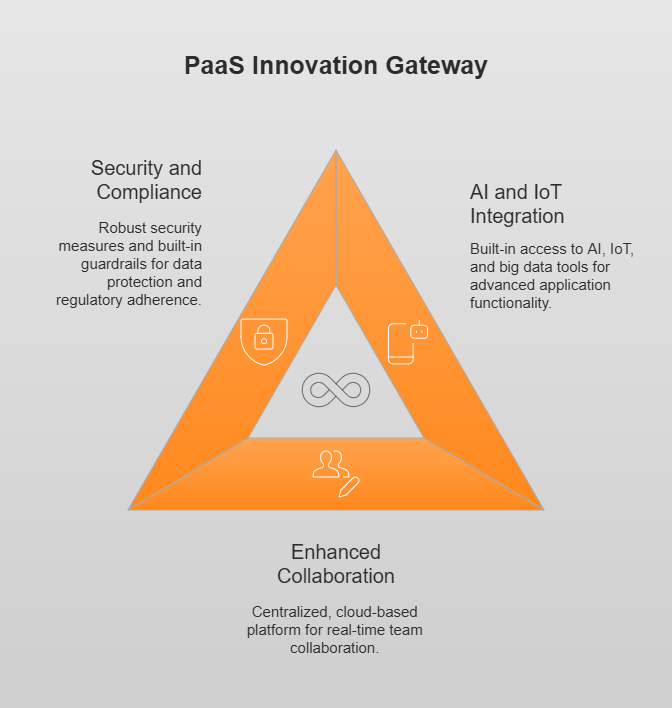
Many leading PaaS platforms come with built-in services for artificial intelligence (AI), machine learning (ML), Internet of Things (IoT), and big data analytics. This provides developers with ready-to-use APIs and frameworks to easily incorporate advanced functionality into their applications. For example, a business can quickly build an application with predictive analytics, natural language processing, or image recognition without needing to assemble a team of data scientists or build a complex data processing infrastructure from scratch. This integrated access to cutting-edge technologies empowers companies to rapidly experiment with new business models and create differentiated user experiences that drive competitive advantage.
By enhancing collaboration, security, and compliance
Innovation thrives in an environment that is collaborative, secure, and well-governed. PaaS enhances collaboration by providing a centralized, cloud-based platform where development teams, regardless of their physical location, can work together in real-time using a shared set of tools and resources. This unified environment ensures everyone is on the same page, streamlining workflows and accelerating project timelines.
Furthermore, leading PaaS providers invest heavily in robust security measures and offer built-in guardrails for governance and regulatory security and compliance. This helps businesses protect sensitive data and meet industry standards, providing a secure foundation upon which they can innovate safely and responsibly.
How can a business strategically implement a PaaS solution?
Adopting Platform-as-a-Service is more than just a technological upgrade; it’s a strategic business decision that requires careful planning and execution to realize its full potential. A successful transition involves a holistic approach that considers not only the technology itself but also the organization’s existing systems, long-term goals, and the expertise needed to navigate the complexities of the cloud. A well-defined strategy is the key to minimizing disruption, maximizing return on investment, and ensuring the PaaS implementation truly drives business innovation.
By creating a clear strategy for migration and integration
The first step in any PaaS adoption is to develop a comprehensive strategy for migration and integration. This involves a thorough assessment of the existing application portfolio to identify which workloads are best suited for the PaaS model. Not all applications are ideal candidates for a simple “lift and shift.”
Some may require refactoring or even a complete redesign to become truly cloud-native. A successful strategy must also map out how the new PaaS-based applications will integrate with legacy systems, on-premise data sources, and other cloud services. This focus on customization and integration ensures seamless data flow across the entire IT ecosystem and prevents the creation of new data silos, laying a solid foundation for a cohesive digital transformation.
By engaging with experts in PaaS application development
While PaaS simplifies many aspects of software development, navigating initial migration, cloud architecture, and cost/performance optimization can be complex. Partnering with a team of specialists can significantly de-risk the process and accelerate the time to value. These experts bring deep knowledge of cloud-native principles, security best practices, and the nuances of different PaaS platforms. To ensure a smooth transition and leverage the full potential of the cloud, it is crucial to collaborate with specialists in PaaS application development who can provide the necessary consulting and technical expertise to guide your organization through every stage of the journey.
How do you choose the right partner for digital transformation?
The choice of a technology partner is one of the most critical decisions in any digital transformation initiative. The right partner acts as more than just a vendor; they become a strategic ally who understands your business vision and possesses the technical acumen to help you achieve it. Selecting a partner requires looking beyond a single technology and evaluating their broader capabilities, their approach to problem-solving, and their proven ability to deliver end-to-end solutions that generate real business impact.
By assessing expertise in cloud-native architecture
When evaluating potential partners, a key differentiator is their expertise in cloud-native architecture. True transformation isn’t just moving applications; it’s re-architecting them to exploit cloud benefits like microservices, containers, and serverless functions. A proficient partner will demonstrate a deep understanding of these principles and have a proven track record of building scalable, resilient, and flexible applications from the ground up. Their expertise ensures that your investment in PaaS results in solutions that are not only modern but also future-proof and optimized for performance and cost-efficiency.
By selecting a comprehensive software development company
The ideal partner is one who can see the bigger picture beyond a single project. They should possess a wide range of capabilities, from strategic IT consulting and UX/UI design to custom development and ongoing support. This holistic perspective is vital for ensuring that your PaaS implementation aligns with your broader business objectives.Ultimately, the goal is to find a holistic software development company that can guide you through the entire digital transformation journey, from strategy to implementation and support. For example, partners like Hicron Software demonstrate this by combining their deep expertise in PaaS and cloud automation with over a decade of experience in legacy system modernization and industry-specific solutions, ensuring a cohesive and strategic approach to enterprise-grade digital solutions.